
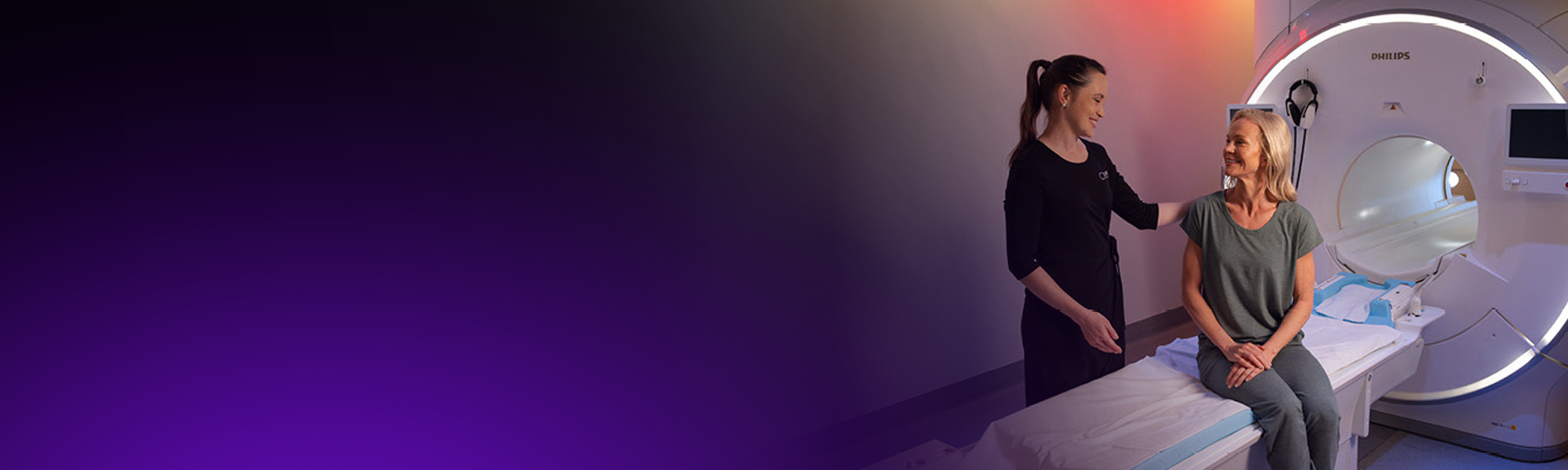

What is a breast MRI?
Breast MRI uses a strong magnetic field and radio waves, not radiation, to create detailed images of the breast. Most breast MRI scans use an injection of contrast and take between 30 and 60 minutes.
Breast MRI scans can be used to find breast cancer, or to rule out breast cancer when other abnormalities are found in the breast. They are often done after a biopsy shows cancer. Breast MRI can be used in conjunction with mammography as a screening tool for detecting breast cancer, especially in people with a high risk or family history of breast cancer. They can also be used to detect a possible leak or tear in a breast implant.
Frequently Asked Questions
Breast MRI is often recommended as a follow-up to mammography or ultrasound, particularly for patients with dense breast tissue or a family history of breast cancer. It can also help assess areas of concern in the chest wall or surrounding tissue or check the condition of a breast implant.
Your specialist or referring doctor may also recommend a breast MRI:
- As part of an ongoing surveillance program if you are considered at high risk of breast cancer, for example due to a strong family history or a known high-risk gene mutation
- To help assess an area of concern when other imaging has not given a clear answer and a biopsy has not been possible
- To help your specialist plan treatment if you have been diagnosed with breast cancer and there is a discrepancy between your clinical assessment and other imaging
- To check the condition of certain breast implants
Medicare rebates are available for breast MRI in specific circumstances, subject to strict eligibility criteria. Your specialist or referring doctor will let you know if you meet the criteria for a rebate.
Both breast MRI and Contrast Enhanced Mammography use a contrast injection and can be useful for people with dense breast tissue. Breast MRI uses a magnetic field and takes longer, while Contrast Enhanced Mammography is a type of mammogram and takes about 15 minutes longer than a standard mammogram. Your doctor will recommend the option that best suits your situation.
Because the MRI machine uses a powerful magnet, it is important to let us know if you have any metallic or electronic implants or devices. You will complete a safety questionnaire at the time of booking and again when you arrive. Please remove jewellery and body piercings before arriving, and avoid wearing mascara or eye makeup, as some products contain fine metallic particles that can interfere with the scan. If your clothing contains metal such as zips, studs or underwire, you may be asked to change into a gown.
If you have ever had an injury to your eye involving metal, please let our staff know, as you may need an x-ray of your eyes beforehand to check that no metal fragments remain.
Before the scan begins, your MRI radiographer will explain the procedure and answer any questions you have. You will lie on a comfortable scanning table, which moves slowly into the scanner. If contrast is required, this is given by injection, usually partway through the scan. The machine does not touch your body, but it does make a loud, rhythmic array of sounds for 2 to 4 minutes at a time. You will be given ear protection, and in many cases, headphones with music. It is important to lie as still as possible to ensure clear images, and you will be able to communicate with your radiographer throughout the scan.
Breast MRI scans are considered very safe and do not use ionising radiation. However, because MRI uses a strong magnetic field, it's important to let our team know if you have any metal or implanted medical devices, including pacemakers, joint replacements, cochlear implants, or surgical clips.
Contrast is generally very safe, but there is an extremely small risk of an allergic reaction. Contrast is not recommended during pregnancy or while breastfeeding unless specifically required. Please let a Qscan staff member know if you have had any previous reactions to MRI contrast.
MRI scans for most regions of the body take up to 25 minutes once everything is set up. Breast MRI usually includes a contrast injection, which can add to this time. Our team can give you a more specific estimate when you book.
The cost of your breast MRI depends on several factors, including the type of scan your doctor has requested, how many regions require imaging, the duration of the scan, and the specialty of your referring doctor. Our customer service team will be able to advise you of all costs involved, including any out-of-pocket costs.
If you think you may feel claustrophobic during your breast MRI, please let us know when you book. We can offer sedation or you can talk to your referring doctor about options.
We recommend arranging alternative childcare for the day of your scan or bringing another adult with you to care for your child. Children are not allowed in the examination room, and there is no supervision available in the waiting area. Our staff need to maintain full focus during your examination to ensure the best possible care.