

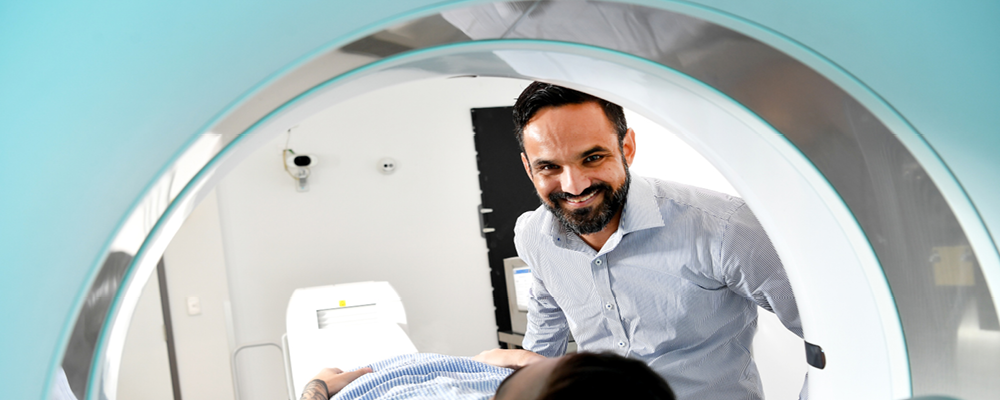
What is a PET-scan?
A PET scan (Positron Emission Tomography) is a powerful imaging test used to detect cell activity in the body, often before structural changes appear on other scans. Using a small amount of radioactive tracer, PET scans highlight areas with unusual cell function, helping doctors diagnose and monitor various conditions, including cancer.
At Qscan Radiology Clinics, we use advanced PET-CT technology, which combines functional imaging with detailed anatomical information. This allows for earlier detection, more accurate diagnosis, and better treatment planning, including the evaluation of surgery and radiotherapy effectiveness. PET-CT scans are often tailored with different radioactive tracers depending on the condition being investigated, and the resulting images provide a whole-body view, highlighting areas of concern with high precision.
What to expect during your PET scan.
Frequently Asked Questions
PET-Scans can be tailored to assess different parts of the body depending on the condition being investigated. While most commonly used in cancer care, PET-Scans also play an important role in evaluating brain function, detecting infection, and guiding treatment decisions in complex conditions. Each scan uses a specific type of tracer designed to highlight certain types of cell activity, which helps your doctor get clearer answers and make more informed decisions about your care. PET-Scans may also be used to assess heart conditions in specific cases, depending on your referral and clinical need.
What is an FDG PET-CT?
FDG PET-CT is the most common type of PET-Scan. It is widely used in oncology to detect cancer, determine how far it has spread, and assess how well treatment is working. It is also used to identify areas of infection or inflammation throughout the body. In addition, FDG PET-CT plays an important role in brain imaging, helping assess disorders such as epilepsy, dementia, and certain types of brain tumours by highlighting abnormal brain function that may not be visible on other imaging tests.
What is a PSMA PET-CT?
PSMA PET-CT is a highly specialised scan designed to detect prostate cancer. It is particularly effective in identifying whether the cancer has spread beyond the prostate and provides greater accuracy in localisation compared with traditional imaging methods.
Our friendly customer service team will advise you of all required preparation at the time of your booking.
When booking your scan, please notify staff if you:
- Think you may be pregnant
- Are breast feeding
- Have kidney failure
- Have diabetes
- Have had a previous adverse reaction to intravenous contrast for CT scans
- Are severely claustrophobic
- Have any allergies
- Are taking any medications
Having accurate dates of your most recent therapies, including surgery, radiotherapy, and chemotherapy, will also help in the booking process.
On the day of your scan, please bring all relevant imaging, if you have had scans conducted elsewhere, so it can be uploaded onto our system for comparison.
You will be given an arrival time well in advance of your camera time, so the tracer can be administered. Tracers decay rapidly after production, and your administered dose has been calculated based on your body weight and to align with your appointment time.
The amount of radiation used in PET-CT imaging is typically small. Health experts feel the risk to your health from this is very small and the benefits of the diagnostic information obtained usually outweigh any potential risks.
If you are pregnant or think you may be pregnant, please let us know.
Before your scan, a cannula will be placed into one of your veins. A technologist will then take you to an uptake room, where the tracer will be administered. It takes 60-90 minutes for the tracer to disperse throughout your body. During this time, you will rest in one of our recliners.
After 60-90 minutes, you will be taken to our PET-CT scanner. You will lie on the scanning bed, which moves through the scanner. It is important that you lie as still as possible while the scanner is operating. The PET-CT scan can take 15-40 minutes, depending on what type of scan you have been referred for. Generally, a PET-CT appointment will take around 2.5 hours in total.
We will let you know how long your appointment is scheduled for at the time of booking. After your scan, a PET-CT technologist will generate the images and upload them onto our private electronic database.
Our skilled PET Radiologists will read the images, create a report, and send it to your doctor. Our radiologists work closely with many referring doctors. They will contact them quickly if needed.
Qscan bulk bills PET-Scans if you have a Medicare eligible referral from a specialist doctor. While a GP can refer you for a PET-Scan, it will not be eligible for Medicare rebate and will incur a gap payment. Some cancers and inflammatory disorders are not covered by a Medicare rebate, even if referred by a specialist, and these referrals will also incur a gap payment.
Our customer service team will be able to advise you of any costs that may be involved with your PET-Scan.
A PET-Scan appointment will take around 2-3 hours, depending on the type of scan you have been referred for. We will let you know how long your appointment is scheduled for at the time of booking.
Our friendly team will advise you of any required after care following your scan. After a PET-Scan you may continue with your normal daily activities, unless advised otherwise by your healthcare practitioner.
We recommend arranging alternative childcare for the day of your scan or bringing another adult with you to care for your child.
Children are not allowed in the examination room, and there is no supervision available in the waiting area.
Our staff need to maintain full focus during your examination to ensure the best possible care.