

What is a brain MRI?
A brain MRI (Magnetic Resonance Imaging) is a safe, non-invasive scan that uses magnetic fields and radio waves to produce detailed images of the brain and surrounding structures. It provides valuable information to help diagnose a range of neurological conditions. MRI scans do not use radiation, making them a preferred choice for detailed brain imaging.
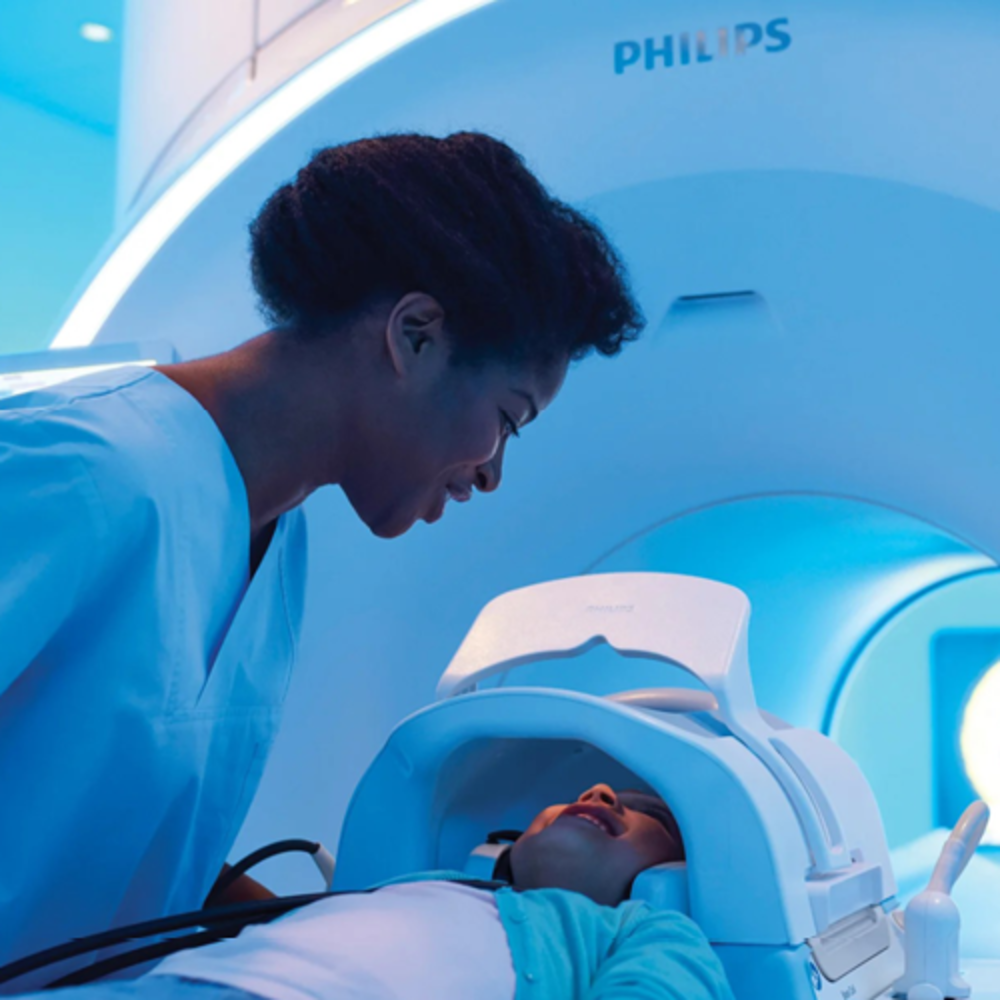
The MRI machine looks like a large tube with a short tunnel through the centre- the tunnel is usually about 1.6m long. You will be asked to lie down on a table which slides into the opening. You will be monitored from our console room and you can talk to the radiographer by microphone between scans. There is also an emergency buzzer available if you need any assistance during your scan.
The procedure is painless. An antenna, which receives image signals from your body, will be placed around your upper region and a camera over your head with a space to look out. This region will be moved to the centre of the MRI scanner for the duration of the scan, but the rest of your body will be outside the machine. You will be provided with ear protection prior to the commencement of the scan, as the machine generates a loud rhythmic array of sounds, which can vary from 2-4 minutes at a time.
It is important that you feel comfortable, calm, and relaxed, as you will be asked to remain as still as possible any time the machine is making a noise. Small movements are fine in the silences/gaps in between scans.
In some cases, a contrast dye may be used to enhance image detail; if necessary, this will be discussed with you beforehand.
At the time of booking and upon arrival, you must complete a safety questionnaire. This is to keep you safe. Patients with certain metal implants may risk damage to their implant or themselves.
Many metal implants have been tested and are safe to enter the room, but others, like pacemakers, can be very dangerous.
The magnet can erase cards with magnetic strips, like bank or credit cards. It can also damage most electronic and mechanical devices, including phones and watches. Jewellery made of conductive materials can get hot. If you cannot take off your jewellery, there are some precautions you can follow. However, please try to remove all jewellery and body piercings before your scan.
Please avoid wearing mascara or eye makeup. The metallic parts in these products can affect your scan. If your clothing has any metal, including zips, bra wires or studs, you may be asked to change into a gown for your safety.
The safety questionnaire is an important part of getting ready for your MRI scan. You will answer the same questions several times during your booking. This is to ensure you are safe to enter the room. Please be patient in answering these questions, as your safety is paramount.
If you have ever had an injury to your eyes involving metal, please inform our staff. You may need to have an X-ray of your eyes to ensure no residual metal fragments are present.
Please let a staff member know if you are claustrophobic. Oral sedation can also be arranged. In most cases, no other special preparation is required for an MRI scan. You might need to follow special instructions for certain scans. If so, a staff member will inform you when you book.
An MRI radiographer will give you a full explanation of the procedure. Please feel free to ask questions if you have any concerns.
A brain MRI typically takes 20–45 minutes. You’ll be asked to lie still inside the MRI machine while the scan takes place. It’s painless, but you may hear some tapping or humming noises, which are normal. If you feel anxious or claustrophobic, our team is trained to help make the experience as comfortable as possible.
The cost of your MRI scan depends on several factors. These include the type of scan your doctor requested. It also depends on how many body areas need imaging, the length of the scan and your doctor's speciality.
Our customer service team can advise you of all costs involved with your MRI scan, including any out-of-pocket costs.
If you think you might feel claustrophobic during your brain MRI, please let us know when you book. You can also talk to your referring doctor about your options.
Modern MRI scanners are much more comfortable than before, with larger bore sizes, improved lighting, faster scan times, and room adaptations for claustrophobic patients. We offer specific room adaptations at our Qscan Windsor, Annerley, and Mackay clinics to help ensure a more comfortable experience.
MRI scans do not use ionising radiation and are considered very safe, especially if you need multiple scans. MRI itself has no known harmful effects.
Sometimes, you might get an injection of a contrast material called gadolinium. This helps doctors see blood flow in the area they are studying. There is a very small risk of an allergic reaction to this agent when it is injected into the body. Please let a Qscan staff member know if you have had any previous reactions to MRI contrast.
MRIs and contrast injections are generally not recommended during pregnancy unless under special circumstances.