
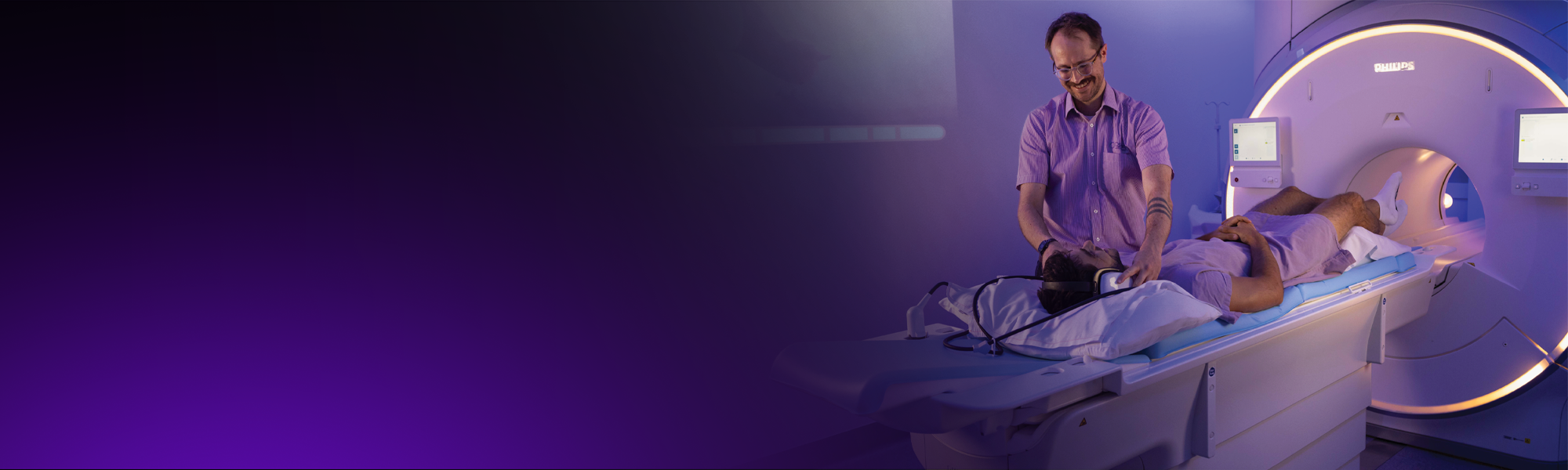

What is an MRI?
MRI stands for Magnetic Resonance Imaging, and is a safe, non-invasive scan that uses a strong magnetic field and radio waves to create clear, detailed images of the inside of your body. MRI scans are especially effective for examining soft tissues such as muscles, ligaments, nerves and internal organs, which are often harder to see with other imaging methods like x-rays or CT scans.
As MRI doesn't use any radiation, it's a preferred option in many cases where long-term monitoring or high detail is needed. It plays a key role in diagnosing injuries, detecting abnormalities, and helping doctors plan the most appropriate treatment. MRI is commonly used to look at the brain, spine, joints, abdomen and pelvis, among other areas.
MRI scans are used by doctors to examine areas of the body in detail and help diagnose a wide range of medical conditions. They are especially useful when other imaging modalities, like x-rays or ultrasounds, don't provide enough information.
Watch our video below to find out what to expect during an MRI appointment.
MRI Frequently Asked Questions
Common types of MRI scans
Qscan offers a broad range of MRI services across multiple specialties. While not all scan types are available at every clinic, our team can advise you on the best location for your specific needs.
Musculoskeletal MRI
Used to assess joints, bones. muscles, tendons and ligaments. Commonly performed to investigate sports injuries, joint pain, arthritis or soft tissue damage in areas like the knee, shoulder, hip or spine.
Neurological MRI
Focuses on the brain. Often used to assess symptoms such as headaches, dizziness, seizures or changes in sensation. Also helpful in diagnosing conditions like multiple sclerosis, strokes or spinal disc issues.
Abdominal and Pelvic MRI
Provides detailed images of internal organs such as the liver, kidneys, bowel, pancreas and reproductive organs. Frequently used to investigate abdominal pain, endometriosis, or assess organs like the prostate and uterus.
Cardiac and Chest MRI
Used to evaluate the structure and function of the heart and surrounding chest area. Cardiac MRI helps assess heart conditions, while chest MRI can offer additional detail when other scan types are not suitable.
Breast MRI
Often recommended as a follow-up to mammography or ultrasound, particularly for patients with dense breast tissue or a family history of breast cancer. Breast MRI can also help assess areas of concern in the chest wall or surrounding tissue.
Prostate MRI
A specialised imaging test used to assess the prostate gland, often to evaluate suspected prostate cancer or other prostate-related conditions. This scan provides detailed images to help identify abnormal growths, assess the extent of disease, and guide biopsy procedures if needed. Prostate MRI can also be used to monitor the effectiveness of treatment and detect recurrence after therapy.
How to prepare for an MRI
The MRI machine uses a very powerful magnet. Because of this, it is important to let us know if you have any metallic or electronic implants or devices in or on your body. Some implants are completely safe, while others - such as pacemakers - may pose a risk. You will be asked to complete a safety questionnaire at the time of booking and again when you arrive. This may seem repetitive, but it is essential to ensure your safety.
Metal objects can be pulled by the magnet or heat up during the scan. For this reason, please remove all jewellery and body piercings before arriving. Jewellery made from conductive materials may heat up, and electronic items, bank cards and credit cards may be damaged if brought into the scan room. Please also avoid wearing mascara or eye makeup, as some products contain fine metallic particles that can interfere with the scan.
If your clothing contains metal such as zips, studs or underwires, you may be asked to change into a gown.
If you have previously had a metal injury to your eye, please let our staff know, as an eye x-ray may be required to ensure no fragments remain.
If you experience claustrophobia, please advise our staff. Oral sedation can be arranged if needed. Some MRI scans may require specific preparation, and our team will advise you at the time of booking if this applies to you.
What to expect during an MRI
Before the scan begins, the MRI radiographer will explain the procedure and answer any questions you may have.
You will be asked to lie on a comfortable scanning table, which moves slowly into the scanner. The machine does not touch your body, but it does make loud tapping or knocking sounds during the scan. You will be given ear protection, and in many cases, headphones with music.
It is important to lie as still as possible to ensure clear images. You will be able to communicate with the radiographer throughout the scan, and they will check in with you regularly.
Most MRI scans take between 20 and 45 minutes, depending on the area being examined. Once the scan is complete, you can return to your normal activities unless you have received sedation, in which case you will need someone to drive you home.
Risks of MRI scans
MRI scans are considered very safe and do not use ionising radiation. The scan itself has no long-term risks and is commonly used for repeated imaging. However, because MRI uses a strong magnetic field, it's important to let our team know if you have any metal or implanted medical devices.
Before your scan, you'll be asked to complete a safety questionnaire. This helps us determine whether you have any metal objects or electronic implants that could interfere with the scan or pose a safety risk. These might include:
- Pacemakers or defibrillators
- Joint replacements or metal plates
- Cochlear implants or surgical clips
- Infusion pumps or nerve stimulators
- Shrapnel, surgical staples or metal fragments
- Certain tattoos or permanent makeup with metal-based inks
- If you have any of these, please inform us before your appointment so we can assess the safest way forward.
In some cases, you may be given a contrast injection called gadolinium to better assess blood flow to the region of interest. This is generally safe but may carry a very small risk of allergic reaction. It is not recommended during pregnancy unless clearly required. Please let a Qscan staff member know if you have had any previous reactions to MRI contrast.
Your safety is our priority, and our team will talk you through any potential risks before your scan.
Once everything is set up, most MRI scans take around 20 to 45 minutes depending on the area being examined. If more than one area needs to be scanned, the process will pause so our team can adjust your position and place the antenna (also called a coil) over the new area. Scanning will then continue as normal.
The cost of your MRI scan depends on several factors, including the type of scan that your doctor has requested, how many regions of the body require imaging, the duration of the scan(s), and the specialty of your referring doctor.
Our customer service team will be able to advise you of all costs involved with your MRI scan, including any out-of-pocket costs.
If you think you may feel claustrophobic during your MRI, please discuss this with us at the time of booking. We can offer sedation or you can talk to your referring doctor about options. Modern MRI scanners are much more comfortable than they were in the past, with larger bore sizes, improved lighting, faster scan times, and room adaptations for claustrophobic patients. We offer specific room adaptations at our Qscan Windsor, Annerley, and Mackay clinics to help ensure a more comfortable experience.
We recommend arranging alternative childcare for the day of your scan or bringing another adult with you to care for your child.
Children are not allowed in the examination room, and there is no supervision available in the waiting area.
Our staff need to maintain full focus during your examination to ensure the best possible care.